Plan a Freelancer Absence Without Leaving Active Projects Ambiguous
Time away is easier to manage when clients know what will happen before, during and after it. Review active commitments, define communication expectations and prepare only the continuity arrangements the work actually needs.
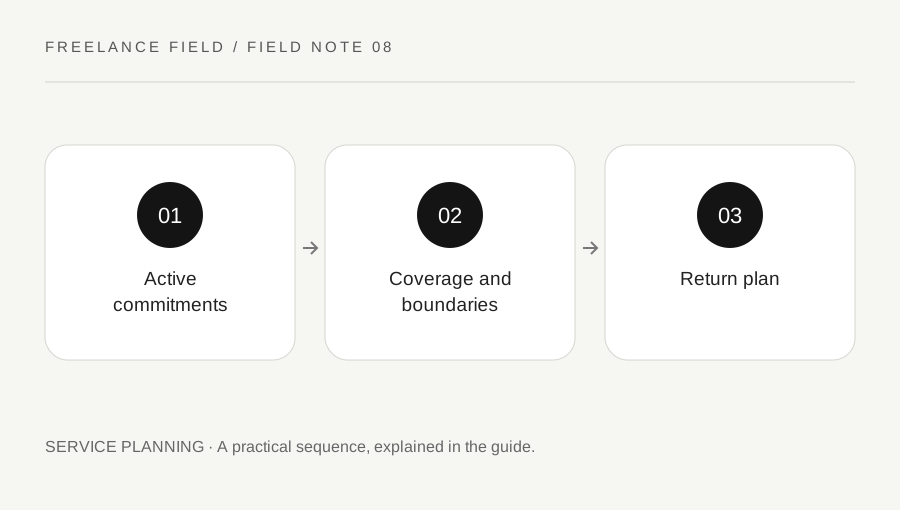
Original explanatory diagram. Examples illustrate a method or decision; they are not claims of personal testing.
Review commitments before announcing dates
List active projects, promised milestones, recurring tasks and outstanding client inputs. Check the relevant agreements and any existing availability commitments. Mark what can finish before the absence, what can wait and what needs a discussion. Do not assume that moving your own production date automatically moves a client launch or external booking.
For an illustrative week away, a final proof may need to be issued earlier, while a new discovery project can begin afterwards. A task waiting for client content still needs a clear status. Review the whole sequence rather than only the days with production work on your calendar. Include reasonable preparation and restart time around the absence.
Communicate the practical effect
Tell affected clients the dates and the consequence for their project in a concise, timely note. State the next milestone, any input needed before you leave and when normal communication resumes. There is no need to share private reasons. A broad holiday announcement is less useful than a project-specific explanation of what happens next.
Ask clients to identify genuinely fixed requirements early. If one conflicts with the planned absence, discuss realistic options through the agreement process. Do not promise to monitor everything just to avoid a difficult scheduling conversation. A vague statement that you will be available if needed can create more uncertainty than a clear and workable boundary.
Prepare continuity only where it is justified
Some work can simply pause; other work may need an authorised collaborator or client-side contact. Decide this from the actual service and risk. Do not introduce a substitute freelancer to confidential materials without the required client permission and appropriate arrangements. A referral is different from delegating existing work.
If coverage is agreed, define the limited task, access, approval route and end date. Provide the minimum relevant context rather than an unrestricted archive. Test any necessary access before the absence and plan how it will be removed afterwards. Keep passwords out of ordinary handoff notes and use the client approved access method for their systems.
Make communication boundaries unambiguous
Set an out-of-office message that gives the return date and an appropriate route for current work. If there is no coverage, say when messages will be reviewed. If a particular urgent channel exists under the service agreement, explain its scope accurately. Do not advertise emergency support that you cannot provide.
An illustrative note might say that new enquiries will be reviewed after a stated date, while an existing project has a named client-side decision owner for the already delivered proof. Avoid including confidential project details in an automatic reply sent to unknown people. Check scheduling tools and website availability so new bookings do not create accidental commitments while you are away.
Reserve a realistic return sequence
Keep space to review messages, confirm changed inputs and reopen active work before accepting a full production load. Sort responses by commitment and consequence rather than simply newest first. Tell each affected client the current next step if something changed during the absence. Do not assume the old priority order remains correct.
Afterwards, note which preparation helped and which ambiguity caused unnecessary messages. Update your standard availability wording and project intake process where appropriate. The aim is a sustainable service with understandable commitments. A planned absence should not depend on a hidden promise to keep working continuously, and it should not leave clients guessing whether an approved project has been abandoned.
A practical checklist
Choices are saved in this browser. Reset them here or clear this site’s browser storage.
Questions that come up
Do I need a replacement for every absence?
No. Assess the actual commitments. Many projects can pause with a clear plan; some services need an agreed continuity arrangement.
Can I share client files with a covering freelancer?
Only with the necessary authority and suitable confidentiality, rights and access arrangements.
Should an automatic reply list active projects?
Keep it general enough for unknown senders. Send project details directly to the appropriate people.
References & scope
Background references checked on 18 October 2026. Worked examples and diagrams are original teaching material.