Set Up Creative Approval When Several Client Stakeholders Are Involved
Several people can contribute useful feedback without sending the project in several directions. Define who gathers comments, who resolves conflicts and who can approve the next stage before a review becomes a collection of competing instructions.
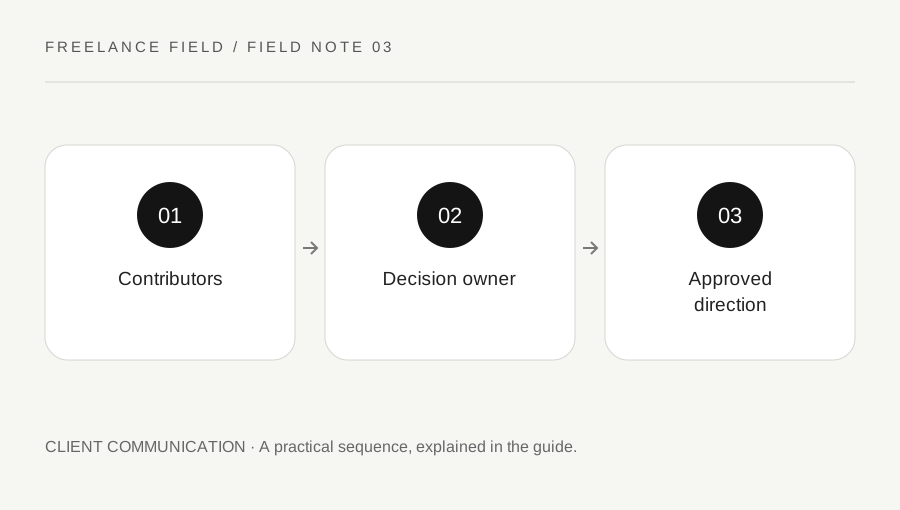
Original explanatory diagram. Examples illustrate a method or decision; they are not claims of personal testing.
Map roles around the decision
Ask who needs to contribute and what kind of input each person owns. A subject expert may verify facts, a brand lead may review visual consistency and a project contact may coordinate the response. These roles do not all require independent authority to redirect production. Record the distinction in plain language.
Identify the person or agreed group that can approve each milestone. Check that this arrangement fits the client’s organisation and your agreement; a project contact may need internal sign-off. Avoid discovering at final delivery that an absent stakeholder must review the entire direction. The practical question is whose decision allows the next piece of work to begin.
Define a review object and a deadline
Send a clearly labelled version with the purpose of the review. State what is open for discussion and what has already been approved. A concept review may ask whether the direction supports the audience and message; a final proof may ask for factual corrections and export checks. Combining both questions invites contradictory expectations.
For an illustrative website hero review, provide one version, the agreed audience, the main message and three focused questions. Ask for a consolidated response by a realistic date that includes internal discussion time. Explain the schedule consequence if the response arrives later. Do not imply that a deadline alone makes the work approved or removes a stakeholder right to raise a genuine problem.
Ask for one consolidated response
Choose one place for actionable comments and ask the client coordinator to gather internal input there. This does not mean hiding disagreement. It means presenting a resolved instruction or an explicitly unresolved question rather than forwarding every fragment of conversation. Make page, screen or frame references precise.
A useful response might say that the headline remains, the product image changes to asset B, and the legal wording awaits a named reviewer. A less useful response contains three conflicting headlines with no preference. Explain this distinction before review. The coordinator can then return a decision set that you can estimate and implement without guessing which person has priority.
Turn conflicts into a decision question
When comments conflict, show the specific choice and its relationship to the project goal. If one stakeholder asks for a dense introduction and another asks for a short one, ask which information the primary audience needs at that stage. Offer a reasoned recommendation, but leave the client decision with the authorised owner.
Do not implement a hidden compromise that satisfies neither request. If the choice affects scope or timing, state that before production. Keep unresolved items separate from agreed corrections so work can proceed only where appropriate. A conflict is easier to resolve as one clear question than as a lengthy email debate about everyone’s preferences.
Close the stage with a visible record
After the response, summarise the approved direction and the changes you will make. Identify any outstanding item and its owner. Label the next version clearly and preserve the prior review record. AIGA discusses client responsibilities and approvals in its agreement guidance; your actual process should be consistent with the contract you use.
At the next stage, show how the consolidated decision was implemented. If a previously settled direction changes, assess it through the change process rather than treating it as an unnoticed correction. After the project, ask whether the review roles worked and update your onboarding questions. Better role clarity can reduce unnecessary rounds without excluding necessary client expertise.
A practical checklist
Choices are saved in this browser. Reset them here or clear this site’s browser storage.
Questions that come up
Should every stakeholder email me directly?
Choose an agreed coordination route. Direct expert questions can be useful, but conflicting production instructions need a clear decision owner.
What if the coordinator cannot approve?
Identify the actual approval route and allow time for it. Do not confuse a communication contact with approval authority.
Can I ignore conflicting comments?
No. Surface the conflict as a specific question and ask the authorised owner to resolve it.
References & scope
Background references checked on 18 October 2026. Worked examples and diagrams are original teaching material.