Define a Small Creative Retainer Around Capacity and a Work Queue
Recurring support works better when both sides understand what can enter the queue and how work moves through it. Define the operating model before treating a monthly arrangement as unlimited access to your time.
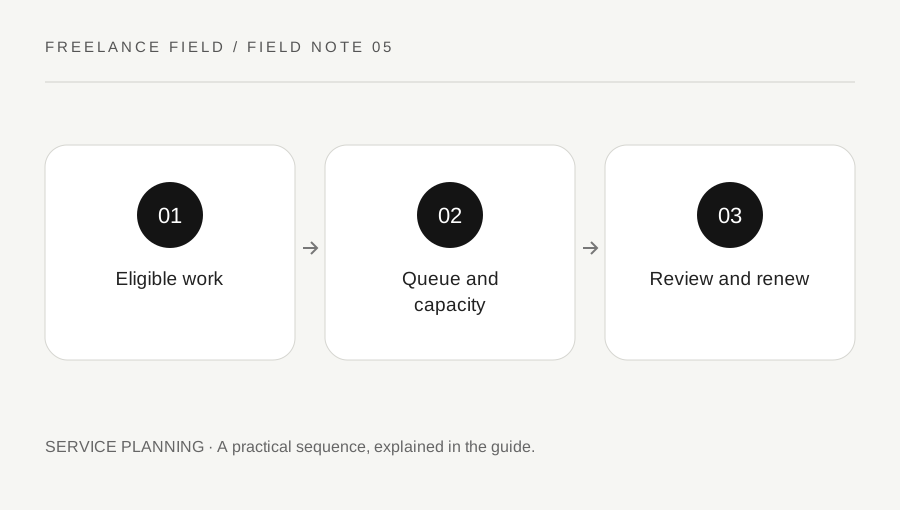
Original explanatory diagram. Examples illustrate a method or decision; they are not claims of personal testing.
Choose a narrow recurring need
Start with repeated work you can describe: updating approved presentation slides, preparing a small set of campaign graphics or maintaining a defined content library. List the inputs and normal output for each task. Avoid offering every creative service under one recurring label, especially when the client has not yet established a reliable volume.
Review a few real prior requests if you have them, or ask the client to describe representative tasks without inventing historical demand. Separate predictable production from new strategic projects. A retainer for adapting approved artwork may need a separate process for developing a new campaign direction. Clear boundaries make the service easier to schedule and explain.
Define the unit of available capacity
State whether the arrangement reserves time, delivers specified outputs or provides another clearly defined service. These models create different expectations. Do not mix them casually by promising both a fixed quantity and unlimited revisions within the same unspecified capacity. Work through the commercial and legal terms with appropriate advice where needed.
For an illustrative capacity model, a freelancer might reserve a defined number of production blocks each month. The operating plan should explain how tasks are estimated against those blocks and what happens when a request is larger than the remaining capacity. This is an example of a planning method, not a recommended price, employment classification or universal contract structure.
Build one visible work queue
Agree where requests arrive and what information makes a request ready. A useful task includes the objective, source content, output dimensions, needed date and approval owner. Mark missing-input tasks separately so they do not appear to be in active production. Let the client choose priorities when the queue is longer than the available capacity.
Use a small status sequence such as proposed, ready, in progress, review and complete. Define those words together. A request submitted on Friday is not necessarily a promise of Monday delivery. Explain the difference between acknowledging a request, estimating it and scheduling it. This reduces confusion without requiring an elaborate project management system.
Make turnaround and interruptions explicit
Describe ordinary lead times and how urgent requests are assessed. A recurring service does not automatically mean continuous on-call availability. Identify working days, communication windows and any planned absence. If emergencies are outside the service, state that plainly in the offer before an urgent situation arises.
Consider an illustrative week with two ready tasks and a new high-priority request. Show which task would move and which approval is needed to change the queue. Do not absorb every interruption invisibly, because the client then cannot see its cost to other work. A clear queue allows a useful tradeoff rather than an argument about effort after deadlines slip.
Review actual use before renewal
At the agreed review point, compare requested work, completed work, blocked tasks and unused or excess capacity according to the agreement. Do not treat a task count alone as productivity: a single complex output can differ greatly from a small adaptation. Discuss whether the chosen service boundary still fits the client’s need.
Record the renewal decision and any agreed changes to scope, availability or process. Clarify carryover, cancellation and other commercial terms through an appropriate agreement rather than informal assumptions. If the work has become unpredictable project work, propose a different arrangement. A successful recurring service is one both parties can operate consistently, not one that produces the largest possible promise.
A practical checklist
Choices are saved in this browser. Reset them here or clear this site’s browser storage.
Questions that come up
Does retainer mean unlimited requests?
Only if that is explicitly and appropriately agreed, with a workable definition. Do not use the word as a substitute for service boundaries.
Can unused capacity carry forward?
That depends on the agreement. Clarify it before the arrangement starts rather than assuming a universal rule.
How should urgent work enter?
Use a stated assessment and reprioritisation process. Show what moves before confirming the new deadline.
References & scope
Background references checked on 18 October 2026. Worked examples and diagrams are original teaching material.